


Contact our support team for more information.
Family Type Protections provides Company and Project Administrators the ability to Monitor, Guide, or Prevent the editing of the type properties of Revit family types, both loadable family types and system family types. Administrators can apply Family Type Protections on a specific family type or by creating rules-based protections. Family types within the project model or Revit template, placed or unplaced, can be selected to protect the type properties from being overwritten by end-users. Additionally, rules-based protections can be created to protect family types. Once activated for the project model, Family Type Protections will display a customized Guardian Command Message when an end-user attempts to edit the type properties of the protected family type.
This action can be fully prevented or can be used to put a message in front of the user to guide them toward best practices. To utilize this feature, it must first be enabled in the Project Configurations for firm-wide adoption or customized at the project level in the Model Settings.
System Family Types; Text and Dimension Styles, Walls, Ceiling, Floors, Structural Members, Pipes and Ductwork, just to name a few, are the foundation to your firm’s graphical and technical standards. When a change is made to a family type, it propagates throughout the project. And far too often, a change is made improperly, or in search of an answer, only to find out later it was correct for a specific aspect of the model, but incorrect in all other uses. When this happens, it adds additional QA/QC time for BIM mangers and technical reviewers to resolve.
Family Type Protections helps prevent these inadvertent mishaps while educating your users on your standards and best practices. With the protections enabled, you will be able to keep track of attempts made to edit the family types, indicating there may need to be a change to your standards.
When Family Type Protections is first enabled within Project Configurations under the Custom Interactions tab, it will be adopted by each project model with that assigned configuration once the model is registered. Family Type Protections can be further customized at the project level within Model Settings on a model-by-model basis. Enabling Modifying type properties rules will activate Family Type Protections.
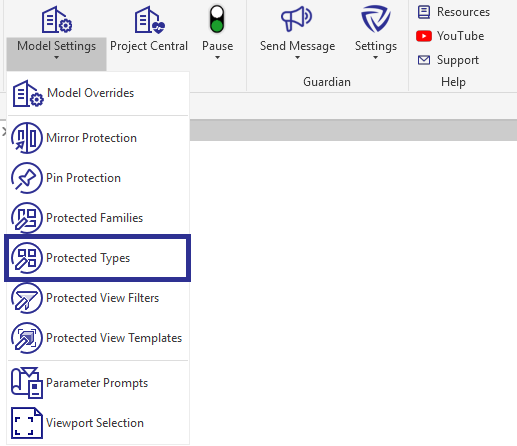
Specific families can be protected with Guardian’s Protected Types. This can be accessed on the Guardian ribbon by selecting the down arrow below Model Settings.
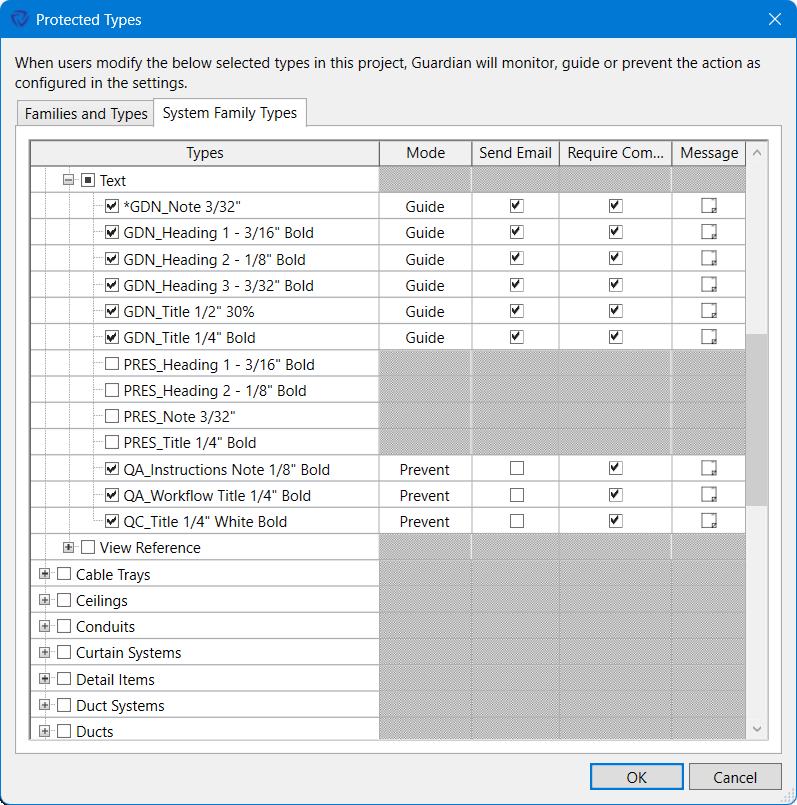
Within the Protected Types dialog, the Project Administrator is presented with all families and their types loaded into the project model, grouped by Family Category.
Checking the box will apply the Family Type Protections for the selected family. Once selected, the Protection Mode and Command Message can be customized.
Pro Tip: Shift+Left Mouse allows to select multiple families at once to be protected.
Any selected family types within the Protected Types dialog will take precedence over any rules created within the Family Type Protection settings in Project Configurations.
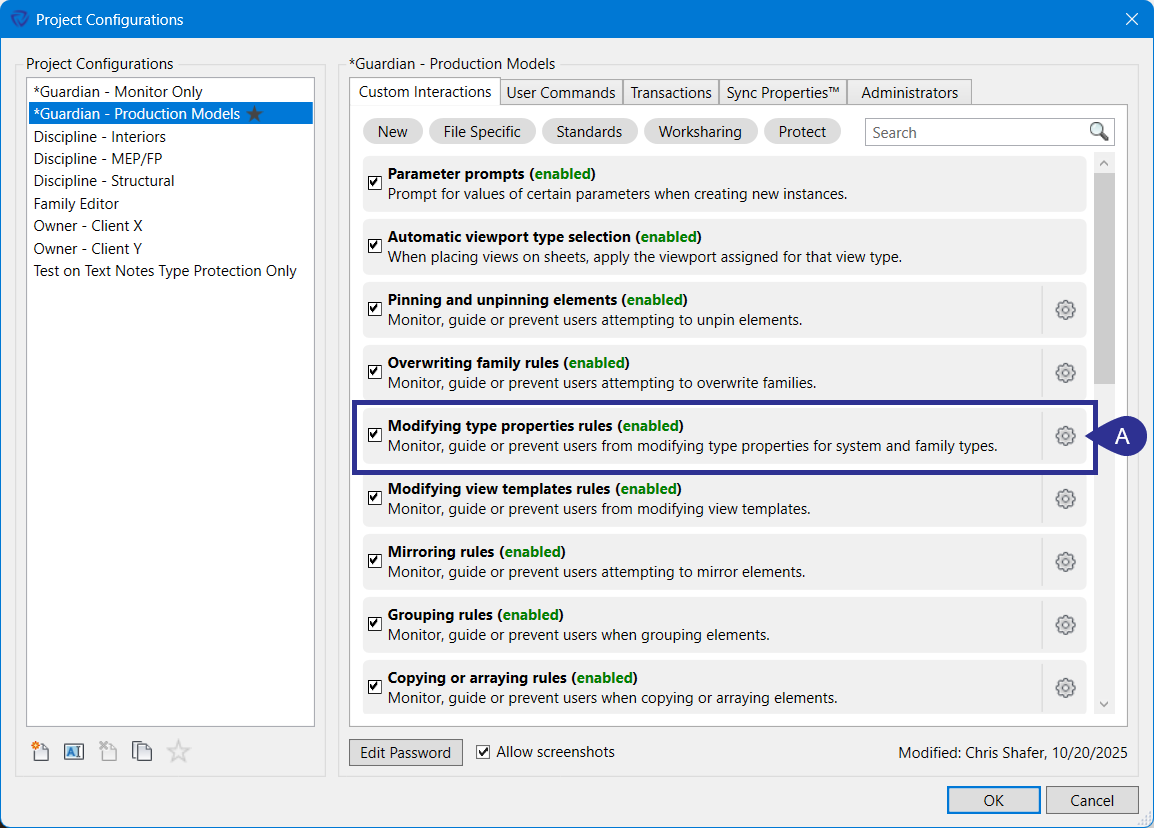
Select the Setting cog (A) to configure rules that will automatically apply the family type protection to any family that meets the rule conditions.
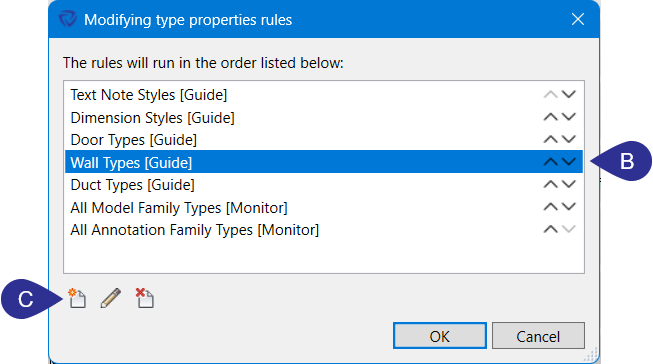
The rules will run in the order listed. Use the arrows (B) to change the order. Select the New button (C) to create a new rule to identify which families are to be protected. Create as many rules necessary for the family types that need to be protected.
Different condition types can be used to create rules to meet specific needs for the Family Type Protections. The different conditions that can be utilized include:
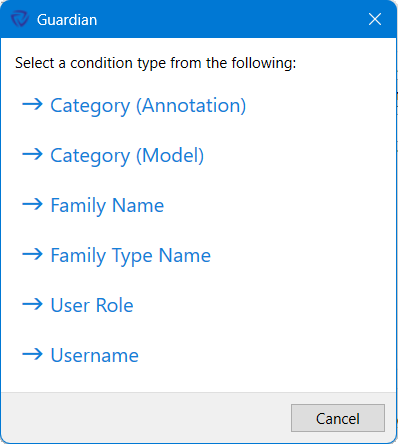
Category conditions can be used to specify specific categories that should be protected. Administrators can also specify categories that should be ignored by the rule.
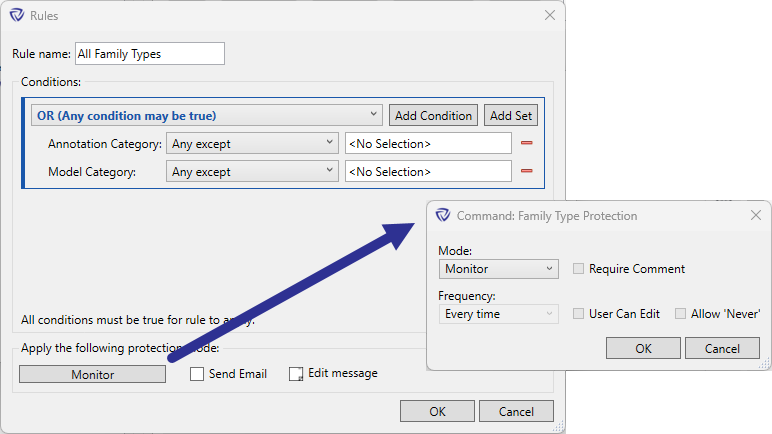
The protection mode can be customized for each rule:
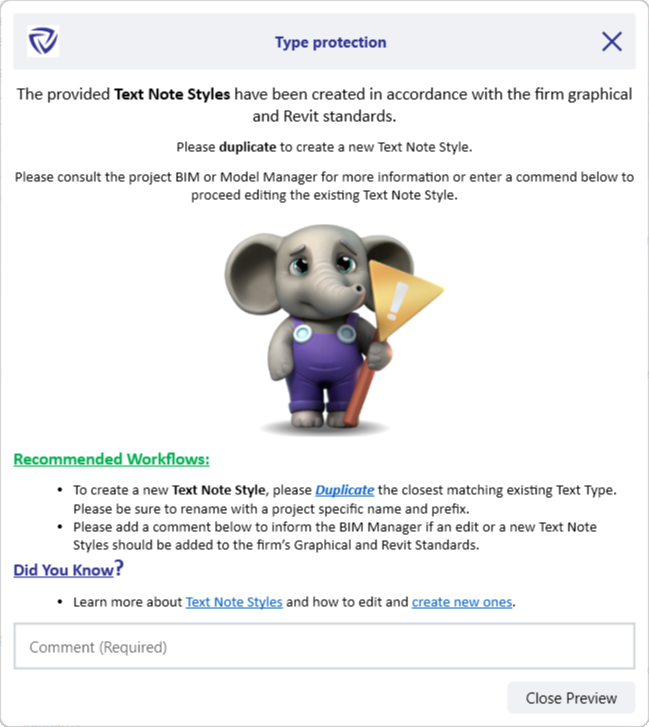
When an end-user attempts to edit a protected family type, Guardian will alert them with the custom Command Message provided by the Project Administrator (if the protection mode is set to Guide or Prevent).
If selected within the Custom Interactions settings for Family Type Protections, the end-user will be required to provide a comment to proceed with editing the protected family type.
If set by the Project Administrator, the end-user will be required to provide the project password or a one-time password to proceed with editing the protected family type.
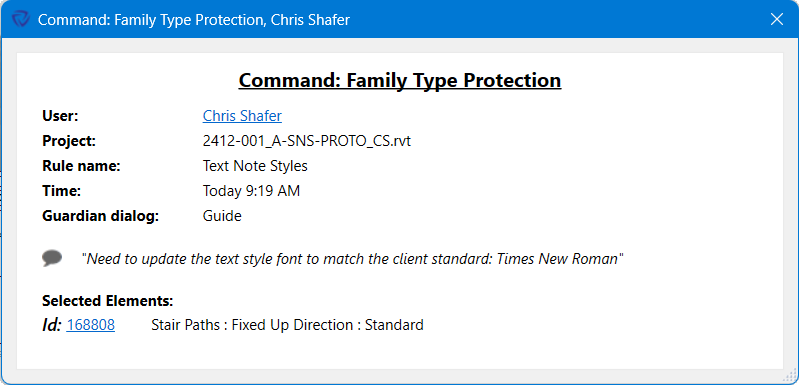
All end-user transactions to modifying a protect family type will show up in Project Central’s Activity Feed, regardless if the protection mode is set to Monitor, Guide, or Prevent.
With email notifications enabled in the Family Type Protections settings dialog, when an end-user attempts to edit a protected family type, the project admin will be notified with an email containing the pertinent information. This is great insight and an opportunity to ask the user what changes they are attempting to make. It could be an indication that the family types need to be updated.
Contact our support team for more information.
Family Type Protections provides Company and Project Administrators the ability to Monitor, Guide, or Prevent the editing of the type properties of Revit family types, both loadable family types and system family types. Administrators can apply Family Type Protections on a specific family type or by creating rules-based protections. Family types within the project model or Revit template, placed or unplaced, can be selected to protect the type properties from being overwritten by end-users. Additionally, rules-based protections can be created to protect family types. Once activated for the project model, Family Type Protections will display a customized Guardian Command Message when an end-user attempts to edit the type properties of the protected family type.
This action can be fully prevented or can be used to put a message in front of the user to guide them toward best practices. To utilize this feature, it must first be enabled in the Project Configurations for firm-wide adoption or customized at the project level in the Model Settings.
System Family Types; Text and Dimension Styles, Walls, Ceiling, Floors, Structural Members, Pipes and Ductwork, just to name a few, are the foundation to your firm’s graphical and technical standards. When a change is made to a family type, it propagates throughout the project. And far too often, a change is made improperly, or in search of an answer, only to find out later it was correct for a specific aspect of the model, but incorrect in all other uses. When this happens, it adds additional QA/QC time for BIM mangers and technical reviewers to resolve.
Family Type Protections helps prevent these inadvertent mishaps while educating your users on your standards and best practices. With the protections enabled, you will be able to keep track of attempts made to edit the family types, indicating there may need to be a change to your standards.
When Family Type Protections is first enabled within Project Configurations under the Custom Interactions tab, it will be adopted by each project model with that assigned configuration once the model is registered. Family Type Protections can be further customized at the project level within Model Settings on a model-by-model basis. Enabling Modifying type properties rules will activate Family Type Protections.
Specific families can be protected with Guardian’s Protected Types. This can be accessed on the Guardian ribbon by selecting the down arrow below Model Settings.
Within the Protected Types dialog, the Project Administrator is presented with all families and their types loaded into the project model, grouped by Family Category.
Checking the box will apply the Family Type Protections for the selected family. Once selected, the Protection Mode and Command Message can be customized.
Pro Tip: Shift+Left Mouse allows to select multiple families at once to be protected.
Any selected family types within the Protected Types dialog will take precedence over any rules created within the Family Type Protection settings in Project Configurations.
Select the Setting cog (A) to configure rules that will automatically apply the family type protection to any family that meets the rule conditions.
The rules will run in the order listed. Use the arrows (B) to change the order. Select the New button (C) to create a new rule to identify which families are to be protected. Create as many rules necessary for the family types that need to be protected.
Different condition types can be used to create rules to meet specific needs for the Family Type Protections. The different conditions that can be utilized include:
Category conditions can be used to specify specific categories that should be protected. Administrators can also specify categories that should be ignored by the rule.
The protection mode can be customized for each rule:
When an end-user attempts to edit a protected family type, Guardian will alert them with the custom Command Message provided by the Project Administrator (if the protection mode is set to Guide or Prevent).
If selected within the Custom Interactions settings for Family Type Protections, the end-user will be required to provide a comment to proceed with editing the protected family type.
If set by the Project Administrator, the end-user will be required to provide the project password or a one-time password to proceed with editing the protected family type.
All end-user transactions to modifying a protect family type will show up in Project Central’s Activity Feed, regardless if the protection mode is set to Monitor, Guide, or Prevent.
With email notifications enabled in the Family Type Protections settings dialog, when an end-user attempts to edit a protected family type, the project admin will be notified with an email containing the pertinent information. This is great insight and an opportunity to ask the user what changes they are attempting to make. It could be an indication that the family types need to be updated.
Contact our support team to receive personalized assistance.
